
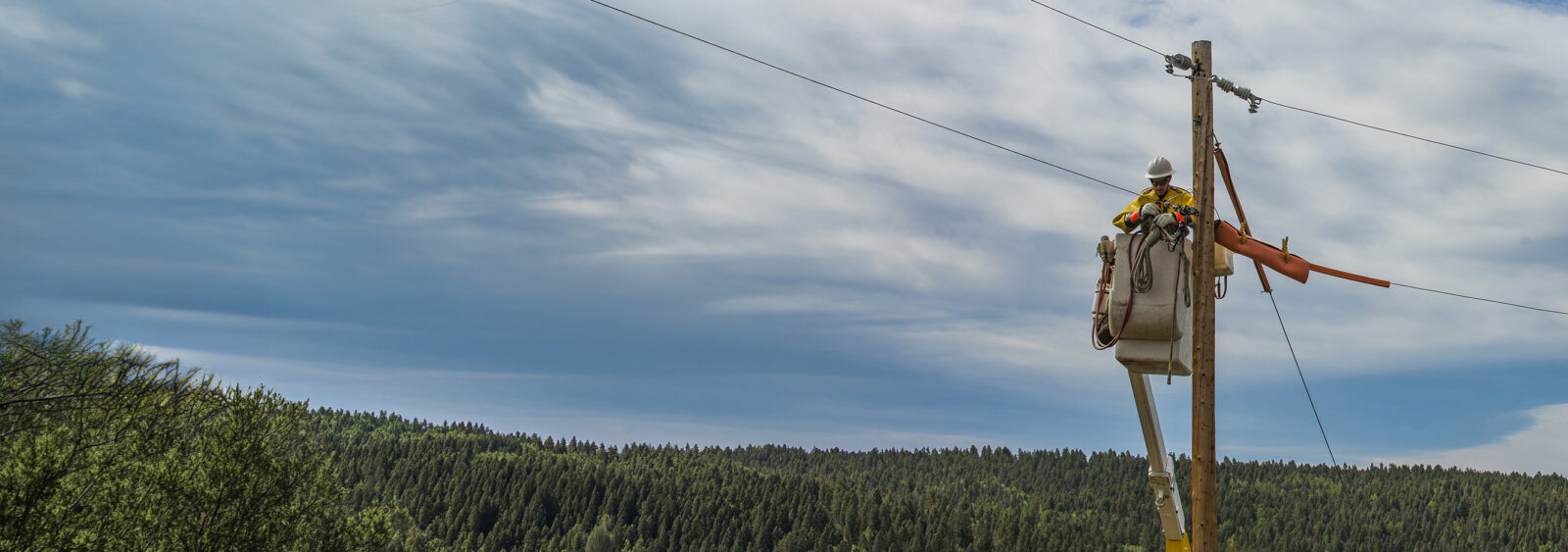
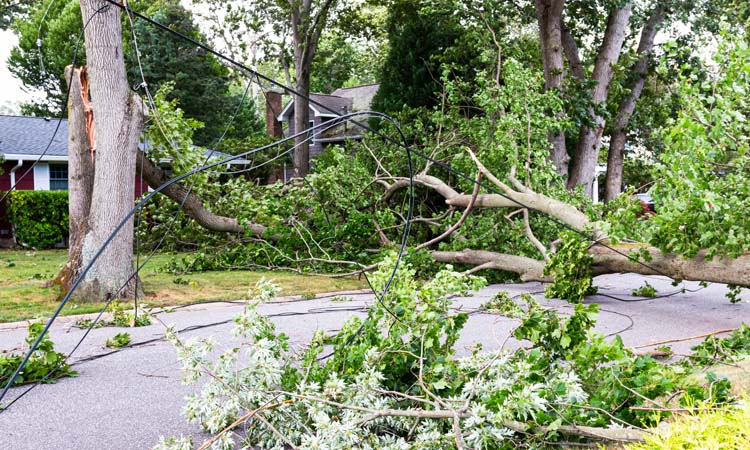
 CORE Electric Cooperative maintains an aggressive vegetation management program to minimize fire risk and outages. We work year-round to clear overhead distribution lines within our 5,000-square-mile service area, on a cyclical maintenance schedule and to address member reports of hazardous vegetation.
Vegetation management along overhead distribution and transmission line rights-of-way helps reduce power outages and enhances safety for our members, employees and contractors. We use an inspection process that identifies vegetation that could be a hazard to the lines and ensures completed vegetation management activities follow our pruning and clearance specifications.
With more than 5,000 miles of overhead lines across CORE’s service area, scheduled pruning and hazard tree removal is staggered over a six-year cycle in which we visit every distribution circuit at least once. To ensure vegetation does not interfere with the power lines before the next inspection, pruning specifications require a clearance between 10 and 24 feet, depending on the species.
If your area is scheduled to be inspected and maintained, you will receive an email notification or mailed notification letter prior to work. You will then be contacted by our pre-inspectors to discuss the work prior to it being performed.
CORE uses qualified line clearance contractors to perform much of our vegetation management work. Trucks and crews performing these tasks in your community will display “CORE Contractor” decals on their trucks. These contractors are required to follow industry standards and guidelines for safety, pruning quality and tree health. Members, property owners and untrained contractors should not prune or cut trees and plants near powerlines.
Please contact us at (800) 332-9540 if you see a potentially hazardous tree or other vegetation concern that threatens our power lines. We will assess the risk posed to our equipment and, if necessary, remove the potential hazard at no cost to you. You may also contact us with any questions, comments or concerns about the vegetation management program.
Explore our frequently asked questions to learn more.
Frequently Asked Questions
Green slash smaller than 4 inches in diameter is typically chipped and hauled from the site, or broadcast back into the right-of-way.
When a live tree is removed from inside or along the right-of-way, the logs are cut into manageable lengths, depending on their diameter, and stacked. Dead and dying trees are cut down to the ground safely, and all material is cut into manageable lengths and stacked on-site.
It is hard to give precise time because we prioritize jobs depending on the severity of the hazard. Additionally, crew workload and availability may fluctuate throughout the year, but most tree issues are mitigated within 6 to 8 weeks.
Members are responsible for reporting obstructions in secondary lines. These are typically single lines stretching from our pole to a member’s home. Obstructions can look like visible tension or abrasion on the electric service line — usually a grey- and black-braided cable connected to your home. This includes fully dead trees that are completely brown, have no leaves or are losing needles and appear to be tall enough to contact our lines or other equipment if they fall.
CORE is responsible for trimming around primary lines. These are lines that run from pole to pole. CORE maintains these because they are high-voltage and require special handling from a qualified tree-trimming crew. Please do not attempt to remove anything in contact with powerlines.
- Do not plant trees or shrubs within 10 feet of the front of underground transformers, or 4 feet on other sides.
- Do not plant trees within the right-of-way surrounding overhead transmission lines, or any tree expected to grow within 10 feet of the right-of-way surrounding overhead distribution lines.
- Plant trees at least 20 feet from distribution or transmission poles and structures. Please see a list of recommended tree species to be planted in our Guidelines for Materials In or Near Rights-of-Way and Utility Facilities.
- Call Colorado 811 before you dig.
- Do not trim trees yourself that are near an energized conductor. Contact CORE at (800) 332-9540 to have them professionally trimmed.
Visit our Pole & Line Work Equipment page to learn more about our pole equipment. Members should be aware of any trees causing tension or abrasion on any secondary or service lines on their property. The lines attached at the lowest part of the pole — phone lines (thin black) or internet/cable lines (thicker black) — do not require the same clearances as our electric lines, and are not maintained by CORE.
There are advantages and disadvantages to under-grounding electric distribution lines. While underground lines are protected from outages due to ice, snow, wind and trees, they are also up to 10 times more expensive to install. Additionally, if outages do occur along underground cables, it takes much longer to identify the problem, fix the issue and restore power.
CORE does work to place lines underground where appropriate, but in much of our service territory the terrain is much too rocky to do this work at a fiscally responsible cost to our members. Our comprehensive vegetation management program is the best, most cost-efficient and effective method to help prevent power outages.