

CORE is committed to the mitigation of wildfire risk to protect our members, employees and distribution system. We have implemented a comprehensive wildfire mitigation plan to reduce the risk that our equipment or facilities cause an ignition, and to limit the consequences of a wildfire in our service area. This plan is intended to safeguard the communities we serve and the landscape we share.
View CORE's Wildfire Mitigation Plan (PDF)





Operational Practices
- Situational awareness: CORE monitors weather forecasts and fuels data daily using advanced services to maintain awareness of fire-risk conditions throughout our service area.
- Alternate relay settings (ARS): During Red Flag Warnings or other high-risk conditions, CORE implements more sensitive circuit protection settings. These settings allow our protective devices to cut power the instant a fault is detected and reduce the risk of ignition. Any outages that occur under ARS are unplanned.
- Public Safety Power Shutoff (PSPS): During rare circumstances in which any ignition could quickly grow out of control, CORE may proactively de-energize powerlines in certain areas to ensure our equipment cannot start a fire. This is a last-resort measure reserved for the most extreme fire danger conditions, and for which CORE will provide as much advance notice as possible.
Inspection Programs
CORE uses drone technology to perform inspections and proactive maintenance of our overhead distribution and transmission systems to address issues that pose risks to safety and reliability. All issues are prioritized and repaired according to their relative risk. Our wooden poles are professionally tested on a 12-year cycle to determine structural health and identify hazards so they can be replaced well before they fail.
Vegetation Management Program
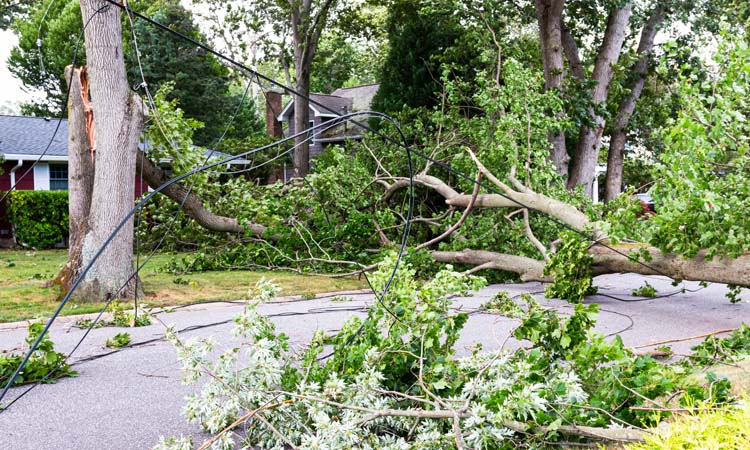
Each year CORE performs proactive vegetation management on scheduled portions of our overhead distribution system to prevent contact between vegetation and energized equipment through the next cycle’s end. Dead, dying and otherwise hazardous trees are removed as part of this work. To mitigate sources of ignition, CORE removes trees and brush around poles where there is the potential for sparks if mounted equipment malfunctions.
System Hardening
CORE continuously updates design, equipment and construction standards to reduce ignition sources and increase reliability. As part of this work, CORE is exploring opportunities to deploy taller poles and stronger conductor in high-risk areas to reduce the likelihood that those powerlines will be disrupted by contact with foreign objects. We also constantly evaluate and install protective equipment — such as faster fuses and programmable reclosers — that simultaneously make the system safer and more reliable.
Emergency Response and Restoration
CORE supports emergency management in our territory by funding AI-enabled wildfire cameras that immediately alert employees and first responders if smoke is detected. In the event of a wildfire in CORE’s service area, our Wildfire Response Procedure identifies roles, responsibilities and actions to facilitate effective communication and coordination with Incident Command.
How You Can Help
Some ways you can make your home and property safer against wildfire:
- Use non-combustible materials for the exterior of your home, especially the roof.
- Keep roof, gutters and wall junctions clean of leaf litter and debris. Embers tend to accumulate in the same areas where these dry fuels collect over time.
- Any gap or opening, such as air-circulation vents, should be screened with a fine (1/8th inch) metal mesh.
- Keep flammable items such as outdoor furniture, equipment covers and firewood from under decks and away from the sides of the house.
- Clear heavy fuels, low branches and space trees apart within a minimum of 30 feet around the house.
If you plan to plant any trees or other vegetation:
- Locate shrubbery, trees and other features so that they will not grow to interfere with lines, transformers and other equipment.
- Do not plant any tree expected to grow taller than 15 feet within the right-of-way surrounding overhead transmission lines, or any tree expected to grow within 10 feet of the right-of-way surrounding overhead distribution lines.
- Plant trees at least 20 feet from poles and structures.
- No trees or shrubs should be planted within 10 feet of the front of underground equipment boxes, or 4 feet on other sides.