

Pole & Line Work Equipment
More than 170,000 poles help us deliver electricity throughout our 5,000-square-mile service area. Most carry our distribution lines and third-party utility services, but many include a transformer and other equipment that keep your lights on.
Learn more about the most common pole-mounted equipment:
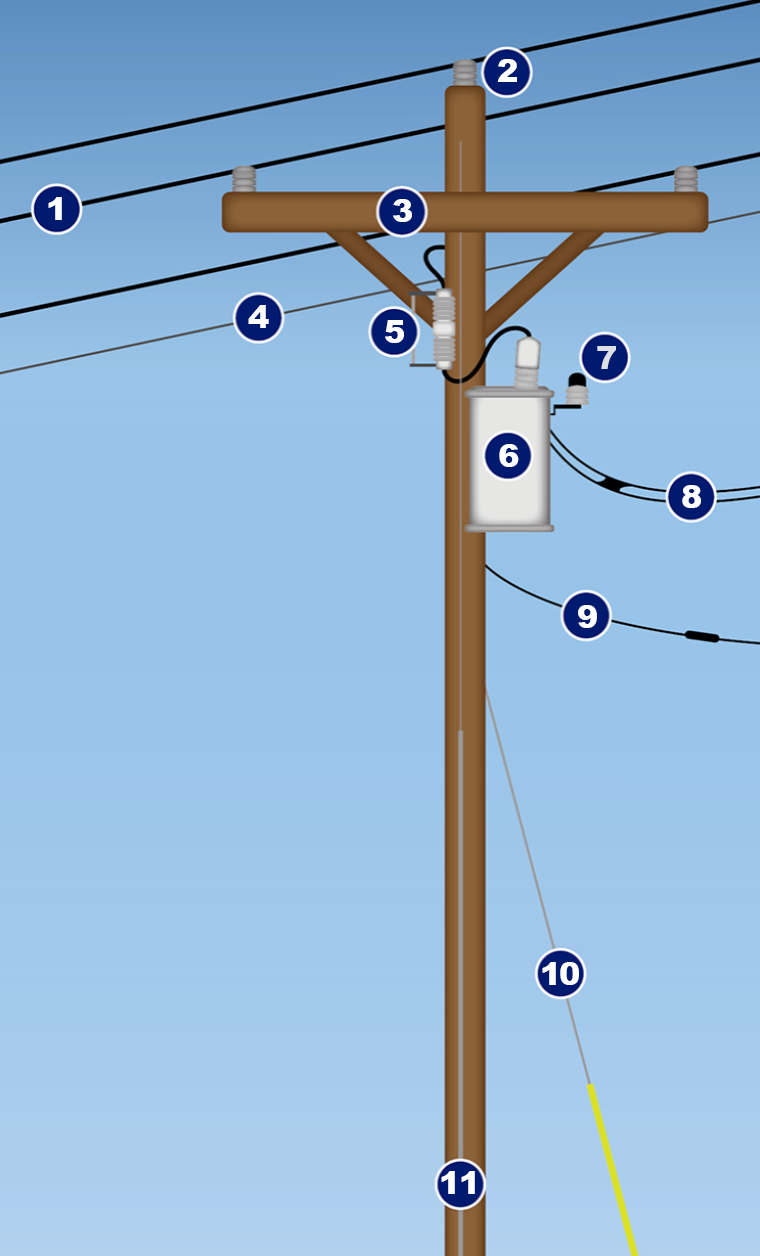
1. Primary lines sit atop the pole. Each carries 12,470 volts of electricity from the substation.
2. Insulators prevent energized lines from touching the pole or crossarm.
3. The crossarm supports the weight of the lines and keeps them separated.
4. The neutral line carries electricity back to the substation to balance the load on the system.
5. A cutout with a fuse opens when there is a problem with the line or transformer. It produces a loud bang when it opens.
6. The transformer converts – or “steps down” – higher-voltage electricity to a lower voltage suitable for most homes and businesses.
7. Arrestors protect the other equipment from lightning and other power surges.
8. Secondary lines (or “service drops”) carry lower-voltage electricity – typically a 120/240-volt split – from the transformer to the point of service.
9. Pole attachments include non-CORE lines, such as broadband, telephone, and cable.
10. A taut guy wire helps stabilize the pole.
11. A ground wire runs the vertical length of the pole and redirects excess electricity safely into the ground.
On top of their skills and knowledge, CORE line personnel go into the field equipped with a variety of gear. Here is a look at just some of their everyday items, courtesy of CORE Journeyman Lineman Eddie McGee.
Learn more about each piece of equipment:
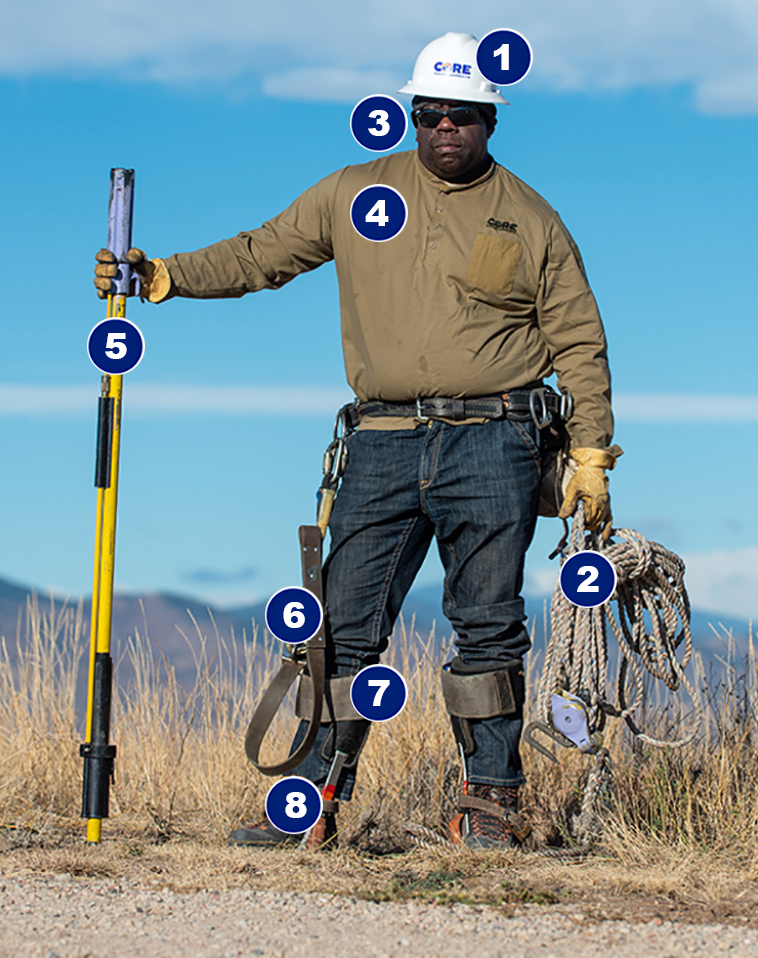
1. Eddie’s insulated hardhat protects his head from bumps and falling objects.
2. Eddie’s handline allows him to hoist or lower materials.
3. Protective eyewear shields Eddie’s vision from arc flashes and makes it easier to see what he is doing.
4. Fire-resistant clothing — including a long-sleeved shirt, jeans and gloves — must cover Eddie’s body so that no skin is exposed.
5. Eddie’s hot stick is used to safely adjust switches, move lines and work with other energized and non-energized equipment.
6. A safety strap is attached to Eddie’s climbing belt and looped around the pole as he ascends and descends. It keeps him secure and his hands free as he performs work at the top.
7. Eddie uses climbers to secure the steel gaffs that dig into wood poles as he climbs up and down.
8. Steel gaffs dig into wood poles so that Eddie can safely climb up and down.
Other essential equipment not shown here: Rubber sleeves and elbow-length rubber gloves, which are used when working with energized equipment; Eddie’s tool belt and canvas ditty bag, which are used to carry nuts, bolts and other materials; a harness to prevent falls when working from an aerial bucket.