
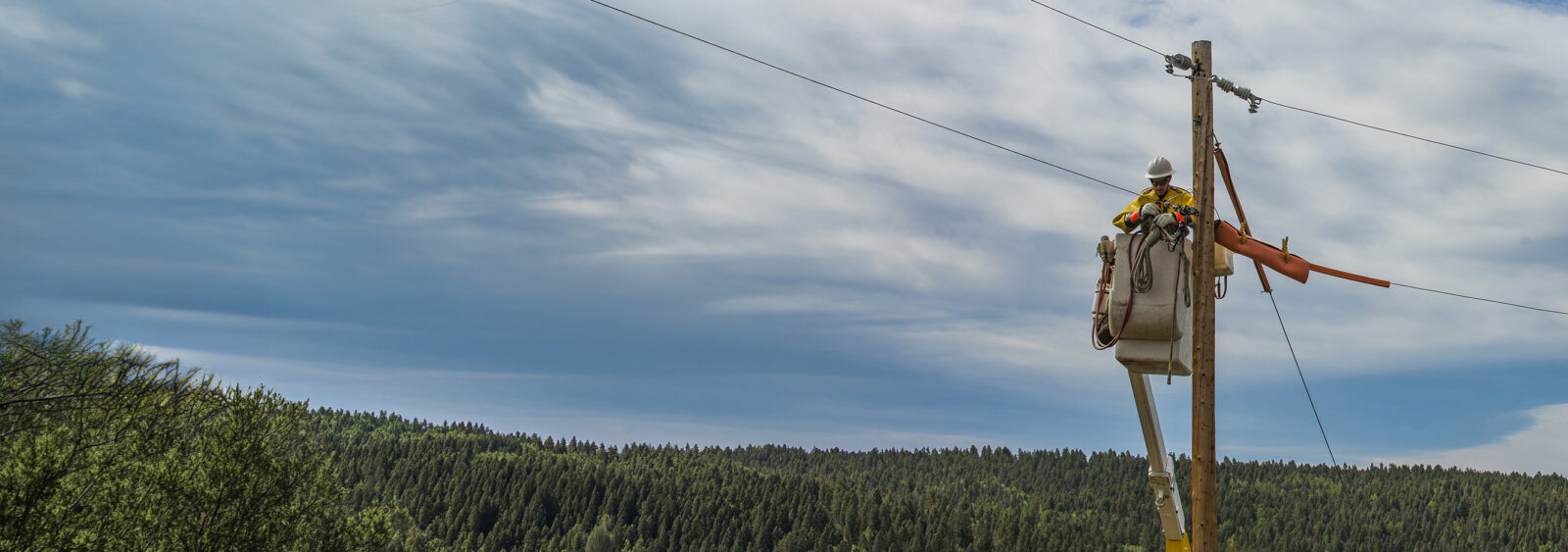
We continually upgrade our system to improve reliability and safety.
The projects detailed on this page represent just a few examples of our ongoing and planned system improvements. Use the interactive map to identify and access additional information about current projects, or click on a project’s title to read more about it. If you have questions or comments, contact us via the form on our Contact page.
Large System Improvement Projects
A new 115kV double circuit transmission line will connect CORE’s existing Citadel Substation and a new substation located within the Dawson Trails development. Construction is expected to start in late 2027, and the line energized in Summer 2028.
The proposed Eastern Plains Reliability Upgrade (EPRU) will replace the existing Strasburg Transmission to Deer Trail 44-kilovolt transmission line with the Wolf Creek to Rattlesnake Creek 115kV transmission line. EPRU will also replace the existing Strasburg Transmission Substation with the new Wolf Creek Substation, and the Deer Trail Substation with the new Rattlesnake Creek Substation. Four routing options will be analyzed for the new 115kV transmission line between the proposed Wolf Creek and Rattlesnake Creek substations. Visit the Eastern Plains Reliability Upgrade website for additional information.
The new Spring Valley Substation and 115-kilovolt double circuit transmission line will improve and provide reliable electricity to members in and around northwest Elbert County. The project construction is complete and was energized in February 2026.
CORE Electric Cooperative has sought the approval of Douglas County to build, operate and maintain a new substation and linked battery energy storage system (BESS) near the intersection of North Ridge Road and East Plum Creek Parkway in Castle Rock.
Learn more about the Monte Ridge Substation project.
CORE will rebuild 9 miles of existing 44-kilovolt transmission line to 115 kilovolts to improve reliability and capacity. Permitting and land rights activities are under way. The project is delayed until the U.S. Forest Service (USFS) determines a solution to resolve nationwide staffing shortages. A second open house meeting will be scheduled once new route options are proposed and discussed with the USFS.
This 11-mile rebuild project started construction in September 2026 and should be completed by April 2027. The existing line will be rebuilt to improve capacity and reliability for the Douglas County area.
CORE will rebuild the existing Shawnee Substation from 44 kilovolts to 115 kilovolts to improve capacity and reliability. The state land board lease agreement is finalized, and payments began in 2025 for new substation limits. County permitting and the substation design are delayed until the U.S. Forest Service determines a solution to resolve nationwide staffing shortages that also impact the Roberts Tunnel – Shawnee 115kV transmission line.
CORE Electric Cooperative has sought the approval of Douglas County to build, operate and maintain a new substation and linked battery energy storage system (BESS) near the western end of Timber Mill Parkway in Castle Rock.
Learn more about Timber Mill Substation.
The redesign and rebuild of the 115-kilovolt transmission line between our Waterton and Roxborough substations was completed and energized in early 2026.
Ongoing Wildfire Mitigation Projects
CORE is committed to mitigating the risk of wildfire and protecting our members, employees and distribution system. Our comprehensive wildfire mitigation plan includes ongoing projects that reduce the risk of wildfires.
CORE uses the Wildfire Risk Map to make important decisions and prioritize where and how to upgrade facilities, underground lines and pilot fire mitigation technologies and equipment. The current map is based on the Colorado State Forest Service (CSFS) Wildfire Risk Assessment Portal that was published in 2017, but in 2023 CSFS published their updated Wildfire Risk Assessment (WRA), which contains updated fuels modeling and fire simulation data provided by Technosylva. CORE uses data from the update in a new internal risk map that combines Fire Intensity and Values at Risk to identify where catastrophic fires have the potential to occur and focus our mitigation efforts in those areas.
Based on the Conditional Risk Level calculated in the updated Wildfire Risk Map, CORE will target areas for strategic undergrounding. If a line scheduled to be rebuilt or brand new construction is within a Level 4 or 5 risk area, it is automatically designated to be built underground, if possible. In certain cases, it may not be possible to construct the new line underground due to line configuration or site conditions. In these instances, the new line is built to CORE’s current standards of hardening and resilience.
CORE continually revises and updates construction standards to incorporate the latest advances and best practices in powerline construction. This helps ensure CORE’s facilities are built to withstand typical environmental conditions of the landscape in which we operate and limit the chances our equipment fails and causes an ignition. The measures include building with taller, thicker poles to withstand high winds and reduce tree-caused outages, using 10-foot crossarms to improve conductors spacing, and installing wildlife protection on energized parts to reduce contact with birds and animals.
Because mitigating wildfire risk while maintaining reliability is a difficult balancing act, CORE continues to invest in grid modernization projects. We have implemented a plan to replace hydraulic oil devices with electronic protection devices that is nearly complete. CORE is also exploring the benefits of increased sectionalizing with more sensitive fuses. This approach is intended to trip very quickly on potentially dangerous fault conditions, but limit outages to a smaller area.
Ongoing Programs of Work
In addition to specific system improvement projects, CORE improves reliability and increases capacity through ongoing programs of work.
The replacement of old transformers with new, well-built transformers helps meet growing member demand.
Reconfiguration of our system improves reliability for members and helps us more quickly restore power.
Continual maintenance of regulators is crucial to the stability, reliability and quality of the electric service we provide.
Replacement of older cables and conductors mitigates fire risk and increases the reliability of our system.