
CORE uses the Wildfire Risk Map to make important decisions and prioritize where and how to upgrade facilities, underground lines and pilot fire mitigation technologies and equipment. The current map is based on the Colorado State Forest Service (CSFS) Wildfire Risk Assessment Portal that was published in 2017, but in 2023 CSFS published their updated Wildfire Risk Assessment (WRA), which contains updated fuels modeling and fire simulation data provided by Technosylva. CORE uses data from the update in a new internal risk map that combines Fire Intensity and Values at Risk to identify where catastrophic fires have the potential to occur and focus our mitigation efforts in those areas.
Based on the Conditional Risk Level calculated in the updated Wildfire Risk Map, CORE will target areas for strategic undergrounding. If a line scheduled to be rebuilt or brand new construction is within a Level 4 or 5 risk area, it is automatically designated to be built underground, if possible. In certain cases, it may not be possible to construct the new line underground due to line configuration or site conditions. In these instances, the new line is built to CORE’s current standards of hardening and resilience.
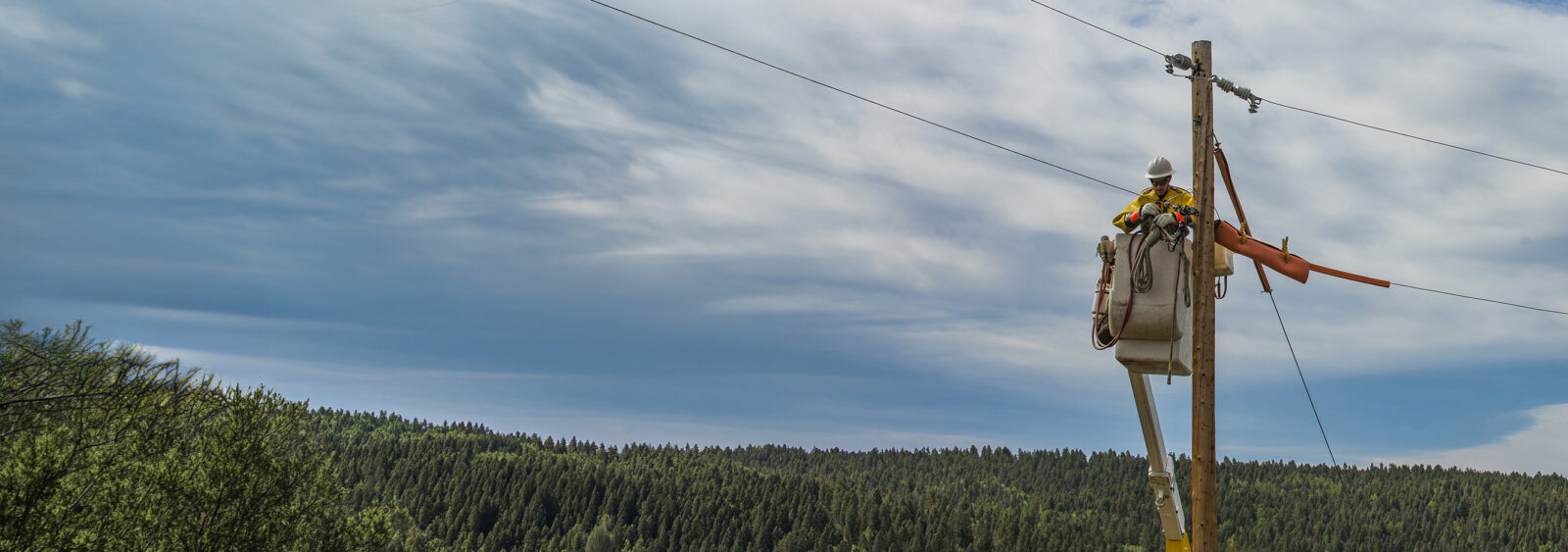
CORE continually revises and updates construction standards to incorporate the latest advances and best practices in powerline construction. This helps ensure CORE’s facilities are built to withstand typical environmental conditions of the landscape in which we operate and limit the chances our equipment fails and causes an ignition. The measures include building with taller, thicker poles to withstand high winds and reduce tree-caused outages, using 10-foot crossarms to improve conductors spacing, and installing wildlife protection on energized parts to reduce contact with birds and animals.
Because mitigating wildfire risk while maintaining reliability is a difficult balancing act, CORE continues to invest in grid modernization projects. We have implemented a plan to replace hydraulic oil devices with electronic protection devices that is nearly complete. CORE is also exploring the benefits of increased sectionalizing with more sensitive fuses. This approach is intended to trip very quickly on potentially dangerous fault conditions, but limit outages to a smaller area.