
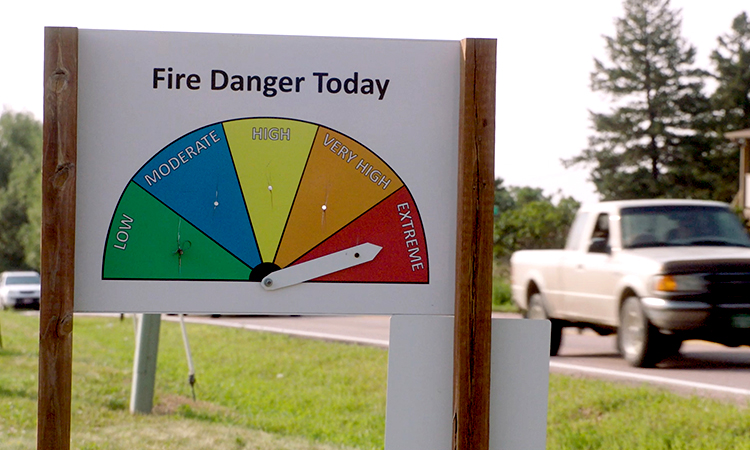
CORE has developed situational awareness tools that provide fire warnings, watches and forecasts for our service territory.
Most of these tools are driven by a geographic information system (GIS) that incorporates wildfire hazard potential maps generated by the U.S. Forest Service’s Fire Modeling Institute overlaid with spatial data representing resources and assets such as power lines, structures and communities. Daily fire risk is also monitored through fire warnings and watches from the National Weather Service, near real-time fire alerts from NASA FIRMS satellites, and social media notifications from fire and police agencies in CORE’s service area.
Our personnel can access this information to adapt CORE’s daily operations, emergency preparedness and risk mitigation efforts to changes in fire conditions. It also allows us to conduct proactive and real-time operations that reduce the risk of fire ignition by our equipment, facilities and activity.
CORE subscribes to DTN Weather Service to receive daily reports of weather conditions in our service territory, including wildfire risk. Additional daily fire risk data is obtained through a combination of map services provided from National Ocean and Atmospheric Association (NOAA)’s Warnings and Watches map service and from the USFS Wildland Fire Assessment System map service. CORE System Operators log weather conditions and send pertinent information and warnings to all Operations personnel and contractors, and GIS republishes these map services to the daily operation map service. This situational awareness allows CORE to adapt daily operations, emergency preparedness, and risk mitigation efforts to changes in fire conditions.
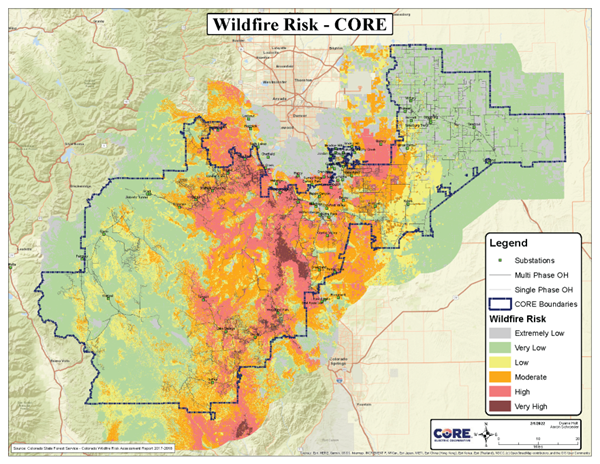
We have developed a system of operating conditions predicated upon each day’s fire risk level:
• Normal allows personnel to operate normally, with no required changes.
• Elevated/Fire Weather Watch cautions crews and contractors to be mindful of elevated fire risk conditions and increase attention paid to situations in which a fire could be ignited.
• Extreme or Red Flag Conditions require that most work on energized overhead lines be halted unless stopping work poses a greater risk. Work that must be completed is done with additional mitigation measures.
Alternate Relay Settings
During High Wind, Red Flag Warnings and other elevated fire risk conditions, CORE implements more sensitive circuit protection settings, which we call alternate relay settings (ARS). ARS react instantaneously to a fault — such as a tree on the line — and limit the line to one attempt to restore, which then cuts the power immediately if the fault is still present. Crews then patrol the deenergized circuit to find and fix the cause of the outage before we reenergize the line. ARS do not preemptively turn off any part of our system, but may create sustained outages instead of blinks.